
I’m not what one may call a car enthusiast; however, I do recognize that they are complex pieces of machinery. Imagine for a moment that each component of your luxury vehicle had a different technician. So, for example, one tech worked solely on the transmission, another on the steering assembly, one on just the front suspension, and one for the suspension on the rear.
You even have a tech who works specifically on the piston crankshafts, completely independent from the piston tech (even though they are physically connected.) The caveat is that they can’t see what the other techs are doing nor observe the work the other techs have completed. Would you be ok with that?
Why Tax-Efficient Investing Requires Coordinated Financial Planning
It’s quite commonplace for this same scenario to be exactly how people operate with regard to their finances and financial plans. You have a broker who manages your investment portfolio, or even just a part of it, and a tax professional who prepares your taxes. Your broker doesn’t see your tax returns, though. What would he do if he did? Would he know what to look for and how the tax code works, or is it more likely that because he works solely on your portfolio, he would miss items that could make you more money?
Here’s an example I see frequently, and it’s simply a product of the financial services industry and how many Americans manage their money. It’s not just a disconnect between brokers and accountants, though; it goes further. Attorneys, financial advisors, brokers, CPAs, etc., rarely work in unison to create a truly holistic total-financial picture for clients.
A comprehensive investment strategy should consider both tax efficiency and risk management, including approaches to downside protection in investing that may help safeguard capital during market downturns.
How Investment Income Can Affect Your Tax Returns
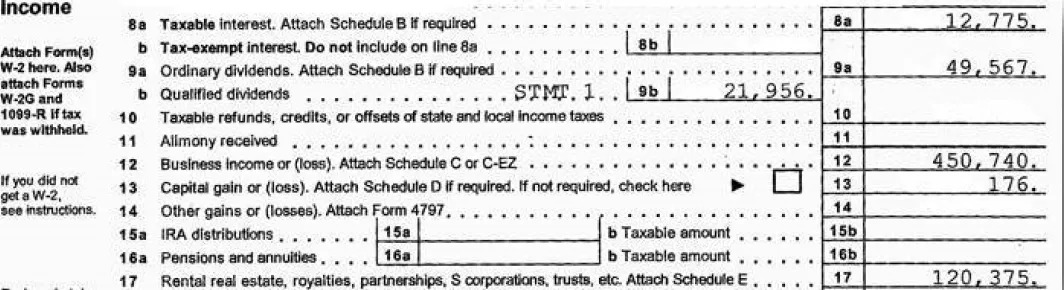
Look at the 1st page of your personal tax return (Form 1040) on lines 8a, 9a & 9b. If there appears a figure there in excess of $1,000, there is likely a disconnect happening in your financial plan and your circle of professionals. If you are in a 35% or a 39.6%+ tax bracket, then you should review relevant and innovative ways to keep those funds from being taxed. If you don’t, the real return of those dividends is likely being greatly reduced by needless taxation.
Understanding how taxes may affect your investment returns is an important part of financial planning. You can also use our investment calculator to explore potential investment growth over time.
Get a Second Opinion on Your Investment Tax Strategy
Our firm and our team of CPAs can easily provide you today with an innovative 2nd Opinion Tax Review. Does your financial plan pass all 5 tests under our Retirement X-Ray Report? Many professionals request these reports from us each month, and their results are outstanding! Additionally, we may be able to obtain money from missed opportunities in previous years. We will help you position yourself today to get the most value out of your time.